







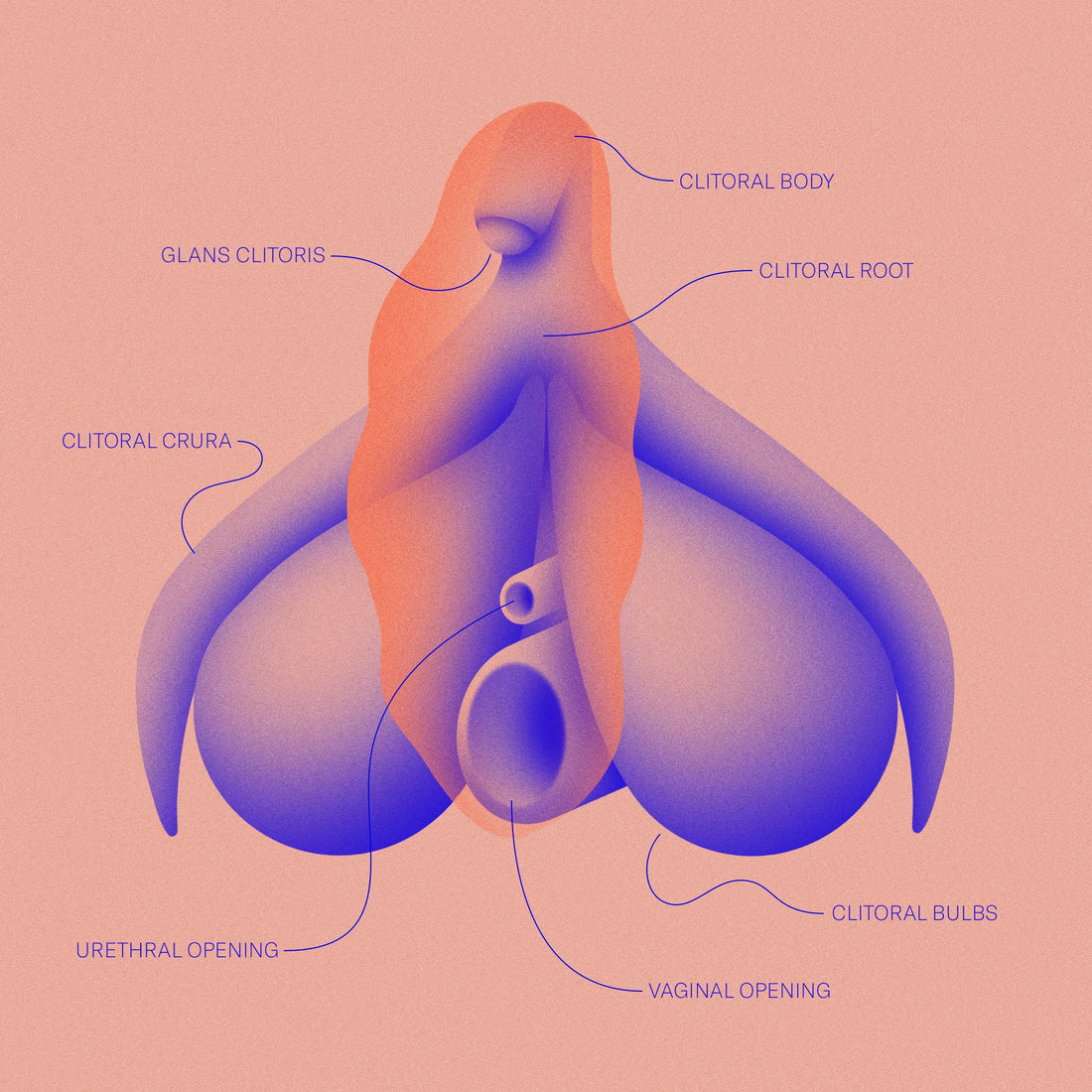
Why Everyone's So Afraid of the Clitoris
8 Min. Lesezeit


You write about the paradox of the nymph who is hyper-sexual yet doesn't have genitalia, and how the word "nymph" is sometimes used to describe the clitoris in French. Do you think this is how we view the clitoris — somehow sexual but not sexual?
Yes, exactly. For a long time, people didn’t know exactly what this organ was for. It took a long time to be anatomically discovered and objectively described, and so there were two main visions of the woman that were predominant for a long time: first, the nymphomaniac, because the clitoris was associated with hypersexuality and hyper-desire. And, on the other hand, because it was so difficult to describe or to locate, the clitoris tended to be assimilated with the “nymphs” that, at the time, meant the labia. So it was this paradox of being an organ of hyper-jouissanceWhy has the clitoris been ignored and erased throughout history? What is threatening about it?
The main reason is that it is an organ that is only devoted to pleasure, and so in that sense, it has been seen as a kind of enemy to reproduction and has been considered the site of feminine jouissance, escaping penetration and escaping male illumination. And I think this is because of the danger that we're presented for the traditional vision of the woman as a mother and a spouse and someone who depends on masculinity to reach pleasure.You write about the idea that the clitoris is only for pleasure, and how western culture deems it almost useless because of this. What sorts of cultural assumptions does this violate, the idea that something could be there just for fun? Do you think this is related to capitalist ideals of productivity?
Yes, exactly, everything has to be meant for something, and it has to be used. I wouldn't say it’s because of capitalism, only because in some societies that are not capitalist — in many tribes in Africa, for example, women are mutilated in order to be deflowered by their husbands only. So I wouldn't say it's because of capitalism only. I think it's because of the conception of the woman as an object and as a servant also.You quote feminist theorist Carla Lonzi as saying that to be “clitoridean” means “thinking in the first person." In what ways do you think being in touch with one's clitoris allows someone to claim their agency and subjectivity?
Her theory was that the clitoris was the symbol of feminine autonomy because it doesn’t depend only on men to attain jouissance and orgasm. And so, symbolically, she meant that women had to be aware of this capacity that they had to be autonomous in their sexuality and eroticism to become aware of their intellectual autonomy. I think this is very true, that you cannot have intellectual or mental autonomy without having bodily autonomy, without being the author of your own eroticism.How do you see mental autonomy and bodily autonomy as linked?
“Autonomous,” by definition, means to not depend upon anyone, to be able to decide what you want, what you’re looking for. It implies a kind of empowerment. When I was young and even a bit older, I was living in a kind of fear. I was always looking for the reactions of my “masters” — I mean, my thesis supervisor or my masculine colleagues. It took me years to stop being afraid and to dare say what I had to say. And now I realize this kind of emancipation went along with an erotic emancipation — when I realized that my future was not necessarily that of a mother, of someone who is on this earth just to reproduce.How do you think, then, that the current political challenges to reproductive rights are affecting women’s autonomy?
It is a total catastrophe. I think what’s happening in the U.S. is, of course, a backlash against all feminist victories and a catastrophe for women. How can you be autonomous mentally, intellectually, ideologically if you have no rights? If you cannot do what you want with your body, if you are forced to have a child you don’t want to have, it’s a catastrophe. And contrary to what many women think, it is not over. We still have to conquer our autonomy.What do you think we can do so that people with clitorises grow up to value and honor this body part?
I think there are a lot of ways to value the clitoris. First of all, people can start talking about it. My book is one in many. There are many, many books and artworks and demonstrations. The problem is becoming more well-known, but what we have to do is, as soon as possible, as much as possible, claim the existence of this body part and affirm everything it represents. It's so amazing to realize that still today, many people, be they men or women, don’t even know what the clitoris is. I think it has to be taught in school and has to be taught more early in school.What do you mean when you write, “the clitoris is an anarchist”?
At the time that I was asked to write this book, I was working on a more developed book on anarchism. Then it appeared to me that perhaps this organ that was not an organ of power — because it’s not penetrating, it was impenetrable — and that was not governable in a certain sense obeyed its own laws. It appeared to me that perhaps it was an incarnation, in the literal sense, of the world of anarchism. That is, an autonomous organ, but also an organ that did not respond to power relations. I think the clitoris is a rebel. I think it acts in a body as someone who doesn’t want to obey, that only wants to obey itself. And it’s not necessarily linked with a woman. AsFeminists today often compare the clitoris to the penis, saying that is has more nerve endings or is just as powerful, or more so. You write in your book that you find this problematic. Why?
I was very surprised to discover such discourse on the comparison between the clitoris and the penis. It tends to transform the clitoris into something like a masculine organ — that is, power, wealth, energy, etc. It is a denial or a negation of this zone of non-power of the clitoris. So, in that sense, I don’t agree with this vision. I think there’s a specific violence against women, and as long as it lasts, I have to find the energy and the courage to talk about the situation of women, not in an essentialist way, but in an attempt to do justice to certain bodies. If we don’t do it, then we have these visions of women as men — you know, like, wealth is the focus of energy, and I think this is not right. The kind of women I would like to see more are the women who are able to affirm themselves without becoming women of power. By that I mean institutional power, editorial power, intellectual power. And this is why I was talking about anarchism. I think anarchism is not represented enough among all the different possible political positions, and I think this is what we need. We need more anarchist rebels, I would say.-

Holiday Gift Ideas for Women: The Ultimate Sex Toy Gift Guide (2025) | Dame
-

Dame’s “She’s Coming” Campaign Puts Pleasure On Wheels
Dame’s "She’s Coming" campaign rolls through city streets with a bold, pleasure-positive message, challenging outdated restrictions and sparking conversations about sexual freedom and empowerment.
-

Why I Started Dame Products: Building Pleasure, Community, and a Culture to Be Proud Of
When I founded Dame Products, my mission went beyond closing the pleasure gap—I set out to build a company culture that champions inclusivity and positive change in women's sexual wellness.
-
 Culture
Die Geschichte zeigt uns, wie Amerika ohne Roe v. Wade aussieht.
Obwohl das Recht auf Abtreibung weiterhin besteht, ist es für viele Amerikaner nur ein Recht auf dem Papier.
- Alle anzeigen


2 Kommentare
I wish I’d had articles like this when I was younger. So much I wish I’d known!
There is so much ignorance about human genitals, especially the clitoris. Thank you for working to alleviate it.
It must be cool to have a part of your body that exists solely for your own pleasure. It’s the most sensitive part of your genitals, like the head of a penis. Like the head of a penis, at birth the clitoris is covered by a prepuce (ie, “hood”). Unlike the head of a penis, the clitoris is protected by criminal law against parental removal of that prepuce.
How wonderful to have that kind of protection for this exquisitely sensitive and private part of your body! I envy you!
VhbMed377@gmail.com